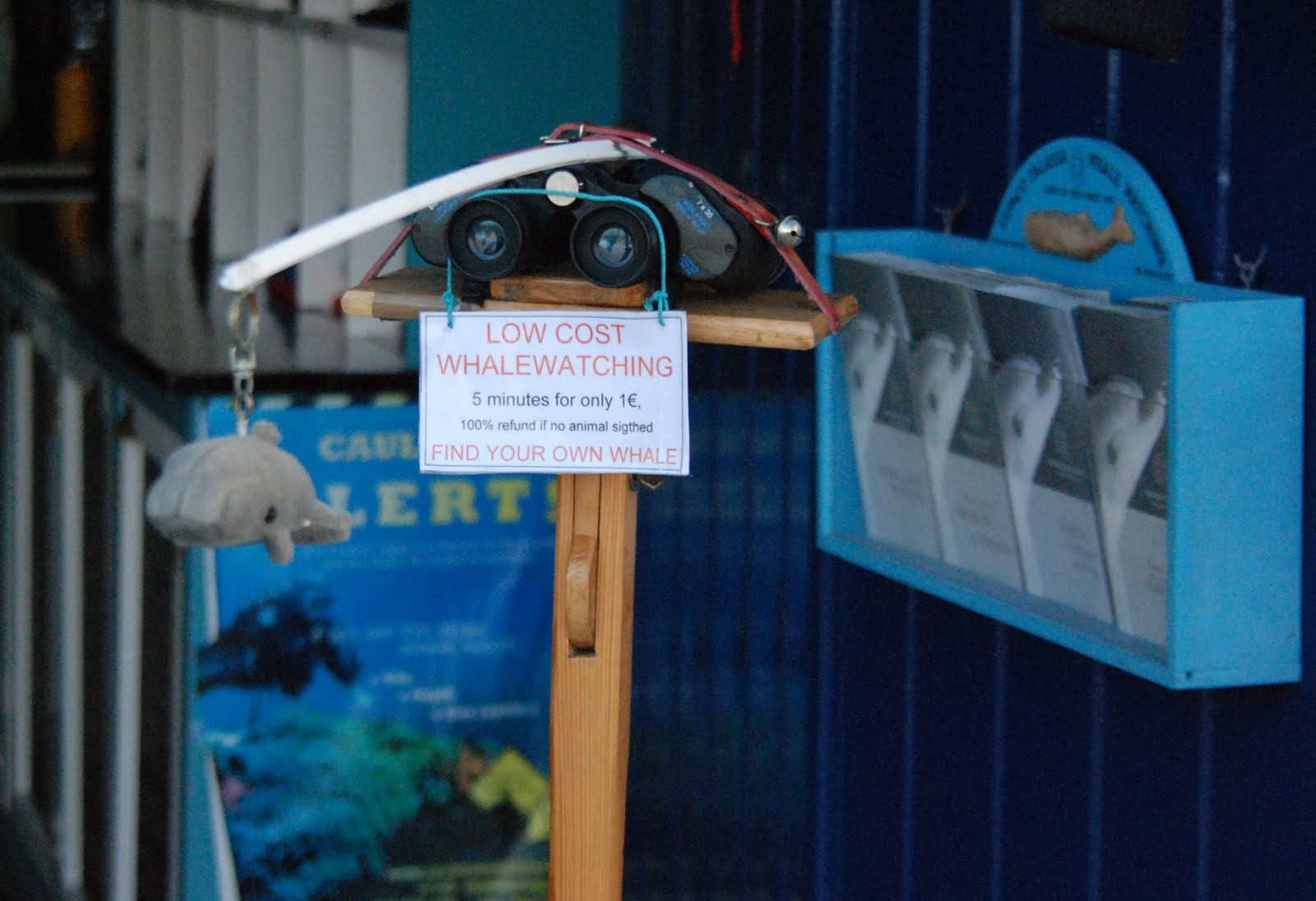
by Espaço Talassa, of course !
Espaço Talassa pretende admitir para a época de 2011
uma pessoa (m/f)
com formação em biologia marinha ou na área do ambiente
Função:
- acompanhamento de clientes durante as saídas para o mar, antes (“briefing”) e após (“de-briefing”)
- actualização diária das estatísticas de observação: http://www.espacotalassa.com/satistiques/index_stats_pt.htm
- gestão das fotografias de Identificação de cetáceos:
http://www.espacotalassa.com/photo_id/photo_id.php
- representar a empresa em eventos internacionais como ECS…
- manter “data” de cetáceos e dar informações à equipa...
Perfil:
- grande capacidade de relação com o público
- carta de patrão de costa ou de marinheiro
- boa capacidade de comunicação em português e conhecimento de uma outra (fluente em inglês de preferência)
- conhecimento em informática - microsoft office (power point)
- de preferência com curso de primeiros socorros
Condições:
- contrato de duração de 7 (ou +) meses Abril/Outubro 2011
- renumeração conforme capacidade (admite-se estagiar L)
- possibilidade de integração nos quadros da empresa
Pede-se resposta com CV detalhado através do e-mail:
Since the 2008 season following a request from Dr. Jonathan Gordon we started the ETID, the Espaço Talassa sperm whale photo-id data collection, not with the purpose of creating a new catalogue, but a photo-id online databank opened to all: curious, whale watchers, students, researchers… where it will be possible to download photos, as well as to include them in already existing catalogues, the reference in this field being the catalogue created by IFAW, Dr. Jonathan Gordon and Dra. Lisa Steiner, in the Azores in 1987.

If you are a regular client or a regular visitor of our website, we are glad to let you know that with the help of Marie Guilpin, a St. Andrews university master student, the effort of the team regarding this 2010 season data collection is already online, so, you can visit the link on our website and if you went out with us this season, by searching the date and time you were at sea you can check the whales you saw and even match them with your own pictures.

Also, this season, after two and half season’s of data collection, curiosity started growing and we decided to do a simple analyses on the whales we id so that we had an idea on the number of different animals identified by us, how are they and how often they visited the south of Pico on the last season´s.

So, from this analyses we saw than 761 photos were taken by members of our team and whale watchers, this 761 photos translate in 235 individual whales, from witch 77 were sighted more than once, so next time you visit us, you can see on an album the whales sighted more than once and also some of the ones sighted only once.
You are welcome to visit our photo Id databank at:
http://www.espacotalassa.com/photo_id/photo_id.php
 Checking the azorean official sighting list, the last time that this species was seen in the archipelago was in 1995 !
 15 years latter, a first record for the Espaço Talassa team, summer 2010 is really special !
  Good for our ego, beautiful photos... but the question is "Why this guys are back ?", well the sea temp is over than 25 º, is it the explanation or part of it ?


When the Espaço Talassa team started going to the sea, 21 years ago the opportunity came to go sea closely one of those “big fishes” imagine the surprise on the discovery that was nothing more than a blue whale, the biggest animal ever to life on heart, and this was how the first sighting of a Blue whale ocorred on the Azores, by 29 may 1997.
After that, sightings of other baleen whales like the Fin, Sei, Bryde, Humpback and even the Minke occurred on this waters during the months of april and may, since there every season during this months we fulfil the dreams of many that want to sea the oceans biggest creatures life on their natural environment.
Every season during the months of April and May, the baleen whales are migrating from the warm waters in the south, were they mate and have their young’s, to the cold north waters were they feed. During this migration they pass in the Azores and that is when we get to see them here in south of Pico island.
Because there is some food availability in these waters, they tend to stay a few days around here. The 2010 season started with a month of April with a regular number of sightings of baleen whales, but then in May something extraordinary happened, we started seeing them almost everyday, and we were so surprised that we decided to make a small statistic analyses with the data that we collect every day.


If we analyse species we can see that the 2006 season was the best regarding Blue and Fin whales sightings, 2001 was very strong on Humpback whales, 2004 on Sei whales and 2002 on Minke whales. And looking at the present season we can see that it’s a good season, but not that much different from other years like 2002, 2006, and 2007.
And we can see that this numbers are not dependent on the number of trips, since in some years with less trips we see more animals that in years with more trips (compare 2004 with 2006, for example).


The reasons for this extraordinary amount of whales around are not fully understood by us, according to the knowledge we have on this animals we can infer that it is probably due to a higher amount of krill than usual, but because we do not develop dedicated research on the food availability here we can’t be sure.
On the year of 1998 Espaço Talassa started identifying Blue whales for Richard sears, and took the picture of the first Blue whale match from the Azores to Iceland, this season, Richard was here and during his stay, until the 15 of May, 15 different Blue whales were identified, at the moment this number is still increasing.
